Monday, August 23, 2010

8: The Mormon Proposition

I will try my darnedest to be fair and honest in my review of this film. I've been interested in seeing it since it was playing at the Newport Film Festival, but didn't want to support the film monetarily because from everything I'd seen and heard it had an agenda and portrayed what I believe in an unfair way. And now after having seen it, I agree. But as a critic, I give my unbiased review below.


8: The Mormon Proposition - I can categorize most modern documentaries into 2 categories, based on Michael Moore's last 2 films, Sicko and Capitalism: A Love Story. Sicko being on the good side of the scale and Capitalism on the other. While both appear to tackle a contemporary issue, Sicko does it well. Capitalism seemed to be too little, too late. Everything in the film had already been in the news so much over the previous few years that the film was merely acting as a receptacle for the topic; gathering it into one place, then vaguely putting a spin on it. The film never attempts to offer any new insight into the issue, other than saying that Americans have a love affair with capitalism to their detriment. You sort of get a sense that Moore is hinting that communism is a better system, but he never addresses it or offers any insight into changing America's apparently screwed up system.
Sicko headbutts the healthcare debacle and doesn't care who stands in its way. Moore gets right into the middle of the issue from the get go. He hits the audience where it's vulnerable and like it or not, what he presents is hard to ignore. By the end, even if you don't agree with Moore's stance, you agree that something has to be done to fix the problem. And maybe because the first time I saw it I was in a dark theater, I actually cried during the film. (Email me if you want to know at what part.) (A hint, it actually was during a part that had little to do with healthcare.)
So where does 8 stand? Closer to Capitalism. It basically is a collection of news and events we've all seen so many times over the last 2 years since Prop 8 passed. It pushes back the curtain on the Mormon church's involvement, showing internal documents about their strategies and showing some video footage of church leaders rallying Mormons to action, but how revealing is that? Everyone knows the Mormon church was involved. And guess what, any organization that's involved in something is going to have "internal documents." Mormons aren't psychic. (Yet.) And what did they reveal? The church wanted to stay out of the public eye, use coalitions, and guess what....get their members involved. This is what Mormons were so worried about getting revealed? I actually was worried that they had footage from the broadcast that I attended, where they asked members to get involved. I thought, 'Oh man, what are they going to show that's going to be out of context and revealing?' Footage of the broadcast was shown intermittently throughout the film, masked behind secret looking graphics(probably because the quality was poor because it was a bootleg copy), but what was said may be shocking to those who have no clue what the Mormons are about, but to anyone else, it was pretty basic. Mormons believe in their religion and beliefs pretty strongly, so why is it a surprise that in the broadcast to members, they invoke the name of their savior and tell the members to use Twitter and blog?
Again, without taking sides, this wasn't very shocking. In fact, any of the tidbits and reveals dealing with Prop 8 weren't shocking at all. In fact, the film is actually very "vanilla" when it deals with Prop 8 and gay marriage in general. Never does the film offer any insight into the issue, any solutions or any unbiased presentation of the pro-Prop 8 stance. It actually hardly even presents the gay marriage stance. What was the point of this film then?
The last section of the film was actually the most thought provoking and eye opening. It deals with the Mormon culture's acceptance of homosexuality (or lack thereof). It looks, very briefly into gay teens, teen homelessness in Utah, and the suicide rate among gay teens. This should have taken up more time. If the filmmakers were bolder, more daring and dare I say it, more like Michael Moore, they would have honestly and directly faced these issues. But they spend a sparse few minutes with a group of homeless teens in Salt Lake, and spend just barely enough time on the suicide rate. But even then, they never get in too deeply into the reasons behind it or offer any solutions or direction.

But this film wasn't about the particulars of gay culture in Utah, it was about Proposition 8, and the Mormon ties to it. It's a shame they never got anyone within the church to be in the film, because I feel like there are so many Latter Day Saints that could have represented the church's side well. And because of that, we were left watching ex-Mormons saying why the church is bad, upset gay couples, liberal politicians, and some stock footage of Utah politicians with big mouths. It's a shame that this film didn't actually address the core of the issue and the points of view involved, because this is such a divisive and pressing issue, and rarely has logic been presented on either side effectively.

Friday, August 13, 2010

Everyone....Meet John Doe

Films get lost to history for several reasons, sometimes they suck, sometimes the reels are lost, but sometimes a filmmaker makes more memorable films that overshadow other good ones. I think that's what happened with Frank Capra's Meet John Doe. Because It's a Wonderful Life and Mr. Smith Goes to Washington are such remembered Capra classics, Meet John Doe is just not mentioned as much as perhaps if it were made by someone else. Maybe if it was made by someone else it would have been totally forgotten, who knows. It's a shame, though, because it's taken me this long to come across this forgotten classic, which I haven't immediately embraced as one of my recently watched favorites.
Meet John Doe is perhaps more Frank Capra than Capra's other films. It's a classic good guy in a dilemma piece, except here there are a few dilemmas. First, we have the newspaper reporter played by the amazing Barbara Stynwick. (Looking less sexy than her Double Indemnity wig wearing self, but still pulling off the working woman reporter cutie look. This was Lois Lane before Lois Lane was Lois Lane.) She loses her job to cutbacks, but writes one last column to stir things up. She writes an "open letter" to the editor saying she's John Doe and is fed up with the world, threatening to throw himself from a building on Christmas Eve. The letter makes a splash, as she hoped, but too big of a splash. People are clamoring for John Doe, to help him, to marry him, to offer him a job. So what does the editor do? First, he listens to her crazy ideas and then he acts on them, hiring a man to play the John Doe, then building him up as a new American hero, writing columns about the travesties in the world.
Next we have the John Doe, who's hired by the paper to play the down and out man. He's humble, perhaps a little too humble. Soon, they have him going around the country, speaking at rallies, inspiring people. A super tycoon invests in the whole enterprise, and then John Doe Clubs start forming all over the country, started by people who want to help their neighbors. A mass of people has join this new cause, all built around knowing your neighbor and helping him, and standing up for the little guy.
Stynwick is torn because it's all gotten so huge, and the tycoon keeps building this bigger and bigger, and she's started to have feelings for John, but where does it all end? It can't end good for them. And then John, of course, is torn because he believes in the message of John Doe, but knows it was built on a lie, and now the tycoon is using him to persuade this new mass of people. How can you keep the message alive, while not exploiting it, especially after the tycoon outs the whole thing after John threatens to expose him.
Then, the last dilemma surrounds the people themselves. The mass of followers that's gathered at a John Doe Convention, quickly turn on him when faced with the reality that John Doe isn't who he says he is. But can't the message of John Doe still last?
This film pre-dates so much of the madness of today's media world. Advertising hits us left and right, and our rational minds know they shouldn't be completely right, but somehow we're persuaded to eat something, or see something, or vote for something. What are the real intentions?
But my favorite part of the film centers around another theme and character, that of John's hobo friend. I failed to mention that John was kind of a hobo, after an accident that ruined his baseball career. As John gets more notoriety, his friend tries to ground him, with speeches about all the leeches that are soon to come. He rants about the freedom that comes from solitude, and how money messes everything up. That's really the essence of the film; no matter how good an idea is it can always be corrupted, just like people. But then, countering that, the real dilemma of the film is, how much do you need other people? Stynwick needs John. The John Doe faithful, who come to his aid even after the truth is revealed, show that John needs them, and of course, they all need each, to look after their neighbors. And then, everyone needs a John Doe, someone to look up to, as well as someone who can ground them to what's really important.
Hoorah!
Watch the linked video about Heelots.
http://www.youtube.com/watch?v=M84XBBd-h_M&feature=related

Wednesday, August 11, 2010

Scarface and Public Enemies

Gangster films are the A-typical Hollywood genre films. They're visually stunning, filled with exciting sequences. They have fun villains, sometimes with cool names. They provide the wish fulfillment that audiences see movies for. And on top of that, they're morality tales, providing metaphors for life and tragic examples of exploitation. At their best, they are all these things. At their best, no other genre offers this much in any single film.

But just like other genres, there are formulas and story arcs, tropes, symbols, the whole thing; all to help the themes play perfectly. The classic gangster films usually got it right, hardly straying from the formula, providing different takes on the same tragic American gangster formula. But none was as pure as the original Scarface. The plot follows the basic outline of Tony, a low-level mobster's rise to power. He takes on the rival gang, going against his boss's advice, building the empire larger and larger. As the empire gets bigger, so does Tony's ego and appetite. He gets his come-uppins in the end when he's pushed the bubble of the empire just a bit too large, dieing in a shootout with a horde of police. (Spoiling the ending doesn't matter, you know going into it, he's gonna get it.)
The original gangster movies were heavy on violence, but subtle on theme. The rules and boundaries weren't overly outlined until The Godfather. In the 30's films, there's mentions of rules, like not killing cops, but there's never too much exposition like in the Godfather films or Scorcesse's films, about staying within boundaries. In Scarface this holds up. Before Tony starts pushing the scene there was a balance to the city and mob life. This mirrored the real life scenarios of gangs and the police, with blind eyes and tip offs and only verbal demands to clean up cities. Of course, that's on the local level, Uncle Sam had a different idea. But gangster films hardly endeavor into the national realm. Most of the classic films deal with local gangsters and their fights with the city and other gangs.
But beyond the structure of that, gangster films really are allegories for life, especially in America. A man pulls himself up, fighting and clawing to establish himself. All he wants is a place of his own and respect. But it's a dog eat dog world, and sometimes accidents happen, it's just the way it is; people get hurt sometimes. Generally, as long as you keep your nose clean, stick to the rules that either society or you, yourself, have established, you'll be fine. And of course, family comes first.
But as you build your life and establish yourself firmly in the upper realms of society, where or when do you stop? When you were a nobody, it was easy to say and easy to keep your ideals. But power corrupts, and tommy guns and cocaine corrupt absolutely. The real lessons we learn are from the great downfalls. And none is greater than Tony Montana's(accent added). He falls, literally, from his huge balcony
The re-make follows the same basic outline as the original, Tony builds his empire but his pride brings him down. The difference though, is that in the original, Tony had some pretenses toward wanting to do right at times and at least being likable. In the remake, you don't like him and his only redeeming quality is his witty gun remarks. But it still follows the genre rules and gives us a hint at what the "Shame of a nation" really is all about. And that's the link to Public Enemies.
Public Enemies follows the exploits of John Dillinger as he escapades around the country, robbing banks and being chased by the Feds. But even though the film is about gangsters, it's not a gangster film. It's really a biopic about Dillinger. And it's actually a rather boring one, at that, which is surprising, considering the subject matter. Half the film follows John Dillinger's love affair with his girlfriend played by Marion Cotillard and the other half is about the Feds chasing him. Dillinger remains aloof basically the entire film, so it's hard to relate to him and care about the character. So much so, that no tears are shed when he gets his brains blown out on a Chicago sidewalk. In a way, the Feds tracking him were far more interesting, and you felt their plight as they stumble and learn the new trade of gangster finding. But their storyline is so basic and left to a mere framework of plot that they have no characters.
So what are we left with? Some cool sequences, like the shootout at the hotel, and the car chases, and a love story we're supposed to care about but can't because we don't know them much. What we should at least feel is the adornment of the people's love and awe of Dillinger and the other '30's era bank robbers. The people loved them, and felt like they were modern day Robin Hoods, or at the very least, brave men sticking it to the Man during a time when people were stuck in the bowels of the Depression. This film could have been an Untouchables, but it never dares to get close enough to any characters for us to like them. And the film hardly gives us a lesson out of the gangster genre handbook.


10 Best Gangster Pics

10.Little Ceasar - perhaps Robinson's best gangster film
9. Bonnie & Clyde - a cultural icon that's about more than bank robbers
8. The Departed - the best modern setting of a gangster film
7. The Untouchables - most all around solid film
6. Goodfellas - this re-invented the genre
5. Casino - forgotten under the shadow of Goodfellas, but better on all accounts
4. Public Enemy - the grapefruit scene alone puts this on the list
3. The Godfather II - the Empire Strikes Back of gangster films
2. Scarface (1932) - the perfect formula for the genre
1. The Godfather - the Godfather of all gangster films


And the 10 Best Gangster Quotes

10. From now on, I want you to put an equal amount of blueberries in each muffin. - Casino
9 "Just when I thought I was out... they pull me back in." - The Godfather Part III
8 "Now go home and get your fuckin' shinebox." - Goodfellas
7 "Is this the end of Rico?" - Little Ceasar
6 "Marriage is an important part of getting ahead: lets people know you're not a homo; married guy seems more stable; people see the ring, they think at least somebody can stand the son of a bitch; ladies see the ring, they know immediately you must have some cash or your cock must work." - The Departed
5 "Leave the gun. Take the cannoli." - The Godfather
4 "I knew it was you, your broke my heart." - The Godfather Part II
3 "Make him an offer he can't refuse." - The Godfather
2 "I'm funny how, I mean funny like I'm a clown, I amuse you? I make you laugh, I'm here to fuckin' amuse you? What do you mean funny, funny how? How am I funny?" - Goodfellas
1. "Say hello to my little friend" - Scarface (1983)

Monday, August 9, 2010

Shutter Island's Plot Made Me shutter

Spoiler Warning! Spoiler Warning! This post is about the wild and un-realistic plot of the Scorsese film Shutter Island. Those who haven't seen it and want to know the idiotic twist ahead of time, proceed. Those who have listened to their Shutter Island loving friends and buy into the radical psychological twist and turny, edge of your seat, thrill ride and want to maintain a sense of wonder when watching, stop right now.

Shutter Island - I won't get into the amazing look and feel of the film. Scorsese does a great job putting all the pieces together to make an immersing thriller. But when you have a film where the audience is just waiting for the Hitchcock reveal the whole time, it doesn't matter. The whole film, we just kept hoping that it wasn't a dream, or that he's really a patient. It had to be better than that, this was Scorsese. Then the government conspiracy plot started to unfold and it seemed like the whole movie was going that way, to the "it's all such a huge secret cover up", reaching the highest levels of government.
That would have been interesting. But still, we hoped for something even twistier, darker or something that hasn't been done.
In truth, part of the actual reveal was darker. In fact, the real story is pretty messed up, his crazy wife drowns their kids and he's so guilt-ridden that he caused his own kid's death, his mind covers it up with a new story. But wait, is everyone else at the institution as insane as he is? Yes. They've been letting the "most dangerous patient" on the island have free reign in the most "elaborate role play" ever conceived. All in an attempt to wake up DiCaprio, or the "board" is going to have him lobotomized.
Movies always tackle plots from the back angle, telling us it was all a rouse AFTER the fact, hoping that since the audience has invested so much into the movie that we'll buy into it. Movies never start the story from the beginning of the rouse. Why? Because we'd walk out/turn off the TV because it's retarded. We'd see right through it.
So, let's re-inact the most elaborate role play from the beginning to see if what the head doctor is doing could be considered logical.
Andrew Laeddis arrives on the island and becomes the most dangerous patient because he hurts the staff, is violent, and is completely delusional(pretending to be a US Marshall on the island). Dr. Cawley (Ben Kingsley) decides, after attempts at permanently awakening Andrew to the truth have failed, that the only way to do that is to let Andrew loose on the island, pretending to be a US Marshall investigating a case. He and the staff act as if there is a patient missing, and they even let him interview some patients, who are given coached answers. I guess they knew what he was going to ask? Then, somehow they engineer a way for him to get to the lighthouse and learn everything. So along the way, how was Andrew supposed to figure out the real truth, when they're all lieing about the missing patient? He isn't, the only way that he figures it out is when Ben Kingsley just outright tells him the whole truth in the lighthouse. And even then, it takes a while to sink in.
So it begs the question....if the board was going to lobotomize this guy for being "the most dangerous patient" on the island, why would they let him loose on the island? Does Dr. Cawley have a Murder Mystery Theatre background? Because he's pretty creative. Pretty damned creative.

Monday, August 2, 2010

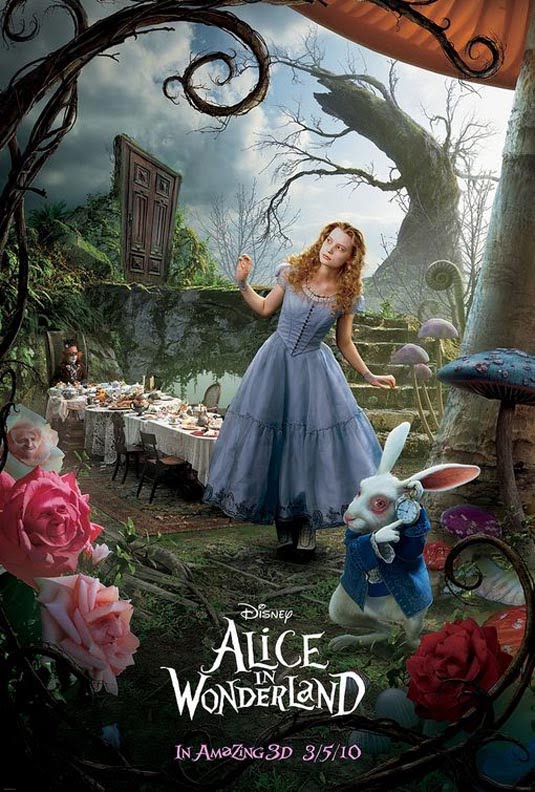
Whip It! and The Chronicles of Narnia: Alice in Wonderland

Two films that have been on the top of our queue for months that both underwhelmed.

Whip It! - There was a tremendous amount of buzz with this film. It's been a "Very Long Wait" for a very long time and has had fantastic reviews. But we were left feeling with a sense of what could have been, rather than amazed at what we were shown. The film is full of little teases that pull you along hoping it's going to be original and fantastic, from the casting....Alia Shawkat (Maebe from Arrested Development), Ellen Page, and my secret crush Kristen Wiig, to the setting of Austin and Roller Derby filled with the awesome quirks of that sport. But the casting just falls flat, Shawkat tries so hard to be funny, and we see little of Wiig, and when we do she's playing so subtle she's hardly on the screen. All that makes me think it's the directing. In fact, I blame it all on the directing, both as the reason for the film's mediocrtity and for the full showcase of what could have been.
This film really should have kicked ass, as a triumphant girl power film with the tagline "Be your own hero." But it so easily falls into the underdog, newbie sport film. It's directed by Drew Barrymore, with a cast of awesome comedic women (and Jimmy Fallen) (also and the guy who plays the coach, my fav character), set in a cool Austin atmosphere of indie...this film should be great. I hoped so much for it, all the way to the end, but over and over it kept dissapointing.
Final thoughts, though, it was pretty funny, it was great to see Maebe on the screen again, and the Derby girls' names were fun. See it, but hopefully you can forget every other underdog sport film ever made and believe this was original.

Alice in Wonderland - Tim Burton somehow found the lost manuscript collaboration between Lewis Carrol and CS Lewis. Apparently, CS wanted to adapt Carrol's characters into one of his books, where there's a girl transported back to a weird world with talking animals, and two monarchs fighting for power, and a big battle in the end where everyone fights, then the girl goes home to England and is better off.
Or maybe it wasn't the Lewises, maybe it was a Disney executive who thought that up, turning Alice in Wonderland into an epic fantasy world with a huge epic battle and all the strange creatures from the book join forces to battle an evil queen. Then somehow Tim Burton got involved and...
And ripped the original heart out, supplanting Alice 10 years later in a sort of sequel where she doesn't remember being there and is the only one who can save Wonderland, which is now called Underland. Why? Because some scroll with the history of Underland says so.
If I was a fan of the book I would be so pissed. I think it was a great and imaginative piece of work, albeit without a plot, but there was a magical theme to it all, hidden inside the chaos of the characters and situations Alice is in. It's as if this movie attempts to make total order of Wonderland, making the characters make sense, work together and give them all purpose. The whole point before was that it doesn't make sense, Alice is lost. She's dismayed that nothing is proper. Now, they've switched that up, where Alice is now out of order and Wonderland makes sense! Then the Mad Hatter does a techno jig and it's over, after an epicish battle between the Red and White Queens.
Final thought, this film can go straight to hell. (Imagine if I was actually a fan of the book.)