Showing posts with label cinema. Show all posts

Monday, September 15, 2014

New Movie A Day: Next 167 Days

Watching a movie a day is really hard. The plan has derailed. In the next 90 Days I only manged to watch 34 movies. So I've caught the list up to present to represent more movies. All in all I've watched 128 new movies this year. So far. There's still over 100 days left in the year to catch up.

Here are some highlights:

Spike Lee films - I went through and watched several of Spike Lee's older films and I have to say I am not a fan. I think they fail on a lot of attempts, either from poor writing, odd formal elements or just that they're really bad. I can't tell if that means Do the Right Thing is that much better or maybe Do the Right Thing is actually not that great. What I think is the case is that he just happens to get the recipe right in Do the Right Thing. He mixes the right amount of social commentary with story. His other early works, with perhaps She's Gotta Have It, the mixture is way off. School Daze is so all over the place and un-cohesive that by the end when all of sudden every black character is out on the quad looking at the camera the message has never sunk in. This awakened moment is un-earneMo Better Blues has a narrative but it's so lightweight that it becomes boring by the second half of the film. And this is the straw that broke the camel's back with Lee acting in his own movies. He's a joke when he tries to act alongside the powerful Denzel Washington. Washington is the best part of that film and He's Got Game. He Got Game is probably the best of the early Spike Lee films, perhaps because it's not that early. But it has a stronger plot and some interesting characters. The B plot with Milla Jovovich really doesn't work and could and should have been cut from the film. Jungle Fever works on a lot of levels, but is really really dated with early 90's music and art direction. John Tuturro and that storyline actually is one of the best parts of the film, overshadowing in my mind even the main plot, partially because Tuturro is so good, but also it's more subdued and not as in your face with its half of the message.
d and out of place.

Major Disappointments - I was so looking forward to Dogtooth. The premise sets up so thoughtfully, but it never fully pays off. It would have paid to have a stronger structure, at least some structure because as is it's slightly random and in-cohesive. La Dolce Vita is a huge disapoint too. Another film where a little more structure would have gone a long way. It too was kind of just a string of scenes, that while are fun and interesting themselves, don't pay off as The Last Picture Show was slightly disappointing. I just never quite got into it. Anchorman 2. Now the definition of major disappointment. The fall off is tremendous from the first film to this one. The one bright moment is the epic newscast fight toward the end, which basically became the point of watching the film once it's realized the film awful.
much at the end.


Slight Disappointments - The Raid 2 will not be making any top ten lists. The first one is so tight and effective. This one is basically a martial arts crime film. Not the worst thing but just not as unique as the first film. My Neighbor Totoro was good but not one of my favorite Ghibli films. Totoro doesn't show up till 45 minutes into it. Although the huge highlight of the film is Catbus, my new favorite character of any Ghibli film.

Major Surprises: After Earth. It really wasn't that bad, just a little bad. The Lego Movie. It's true: Everything is Awesome, including this film. The hype is justified, it's super fun and awesome. I was nauseous the whole film and managed to hold off throwing up until the very end when I ran to the bathroom and vomited into the movie theatre toilet. The movie good enough to hold off my vomit. Totally worth it.

The Grand Budapest Hotel - My favorite film of the year.
I smiled the entire time in the theater. It was so delightful.
All is Lost - I think there are two or three bits of dialogue in the whole film. Amazing. Perfect minimalist film making, it's captivating from start to finish.
The sound work is stunning as well, there are other parts where the sound is prime in telling the story so well.


79. Apr 2 - 12 Years a Slave - award winner
80. Apr 2 - Fail Safe - compare to Dr Strangelove
81. Apr 3 - Anchorman 2 - just for funs
82. Apr 5 - Much Ado About Nothing - love the play
83. Apr 6 - He Got Game - unseen Spike Lee film
84. Apr 7 - Freakonomics - prep for class on Documentary
85. Apr 9 - Empire of the Sun - unseen Spielberg film
86. Apr 12 - Doctor Zhivago - unseen AFI Top 100 film
87. Apr 14 - Mo Better Blues - unseen Spike Lee film
88. Apr 15 - End of Watch - student suggestion
89. Apr 16 - Thor: The Dark World - pop culture
90. Apr 18 - School Daze - unseen Spike Lee film
91. Apr 19 - Blackboard Jungle - youth culture study
92. Apr 22 - Another 48 Hrs. - study of film sequels
93. Apr 27 - My Neighbor Totoro - unseen Miyazaki film
94. Apr 27 - Foreign Correspondent - unseen Hitchcock film
95. Apr 28 - The Guilt Trip - on the dvr 
96. May 2 - The Three Faces of Eve - students paper on mental illness on screen
97. May 6 - The Grand Budapest Hotel - Wes Anderson!
98. May 10 - Jungle Fever - unseen Spike Lee film
99. May 11 - After Earth - on the DVR, pop culture
100. May 12 - Muppets From Space - with the boys
101. May 14 - Frances - a students paper on mental illness
102. May 15 - Princess Mononoke - unseen Miyazaki film
103. May 17 - The Lego Movie - with the boys
104. May 20 - Dogtooth - sounded extremely interesting
105. May 24 - Escape from Alcatraz - unseen prison film
106. May 28 - Westworld - unseen sci-fi classic
107. May 31 - Escape From Tomorrow - pop culture, indie film
108. June 7 - Wall Street - unseen classic
109. June 8 - Freebirds - with the kids
110. June 16 - La Dolce Vita - unseen foreign classic
111. June 19 - The Firemen's Ball - unseen Milos Forman film
112. June 22 - All is Lost - unseen film from 2013
113. June 29 - The Secret Life of Walter Mitty - pop-culture
114. July 1 - Bringing Out the Dead - unseen Scorcese film
115. July 5 - Begin Again - went to the theater
116. July 8 - Shadow of a Doubt - unseen Hitchcock film
117. July 9 - The Last Picture Show - unseen classic
118. July 15 - The Life of Emile Zola - unseen classic
119. July 20 - All of Thomas Edison's short films to 1903 - unseen classic
120. July 21 - Tiny: A Story About Living Small - interesting doc
121. Aug 7 - The Raid 2 - just for funs
122. Aug 10 - Magnificent Obsession - unseen Douglas Sirk film
123. Aug 15 - The Cat Returns - unseen Studio Ghibli film
124. Aug 21 - Lone Survivor - pop culture
125. Aug 24 - Amazing Spiderman 2 - pop culture
126. Sep 2 - Saftey Last - unseen silent comedy classic
127. Sep 9 - August: Osage County - awards contender
128. Sep 10 - Captain America: Winter Soldier - pop culture

Wednesday, December 19, 2012

Kung Fu Panda 2 and the Modern Sequel

It's an unavoidable fact: Hollywood makes sequels. They even make sequels to sequels. Those are called "threequels." And as everything Hollywood does, there's a pattern to how they're structured, sometimes good and sometimes awful. And just like with most movies, there's usually a pattern to the whole process, and the more and more franchises Hollywood makes, the more they're exploited and the easier they are to notice. The modern day sequel has been even more patterned with the advent of the trilogy. Now, three movies can follow that pattern. The first film of a franchise is usually pretty standard, whether it's The Godfather or Green Lantern. But just as the first film is usually patterned(and noticed for it's pattern after the sequel comes out), the sequel is just as patterned as the first film.
I can pinpoint the birth of the modern day sequel to The Godfather Part II. It was the first major film to recognize in title that it was a sequel. Before this, Hollywood shied away from calling a sequel a sequel and giving it a numerical designation. The Godfather revitalized the film industry, making more money than a film had made in a long time. A sequel today would be a no-brainer, but back then it was sort of a risky idea. But with the success of the first film, Paramount felt like it was a good idea to directly associate the second film with it. 
Soon there were other sequels and franchises popping up in the 70's and early 80's; French Connection II, Jaws, Star Wars, Indiana Jones...Hollywood now wasn't just making sequels they were making franchises; film empires that could sustain themselves through not only film revenue but through other media and merchandise. 
Enough film history. Let's look at the patterns that started way back then and are still being used today in sequels. First off, it should be noted that trilogies could be looked at as one long three part movie. With the first being Act One, the second being Act Two and the third being Act Three. The first act sets up the hero, sets up the world and the major problem, and ignites the hero on a wider adventure. The second act is the big ordeal the hero goes through, perhaps it is the hero's darkest hour or an unmasking where he learns who he really is and who his enemy really is. The third act sets up the final conflict and resolves the turmoil.
In franchises, the first film is usually some sort of origin, especially in super hero films. The hero comes to terms with who he is and begins his quest in the "New World." First films vary widely, usually following the same basic story structure, but the big difference is that at this point its not always knowable if the film will turn into a franchise.
Third films vary even more, but that can be attributed to other non-story elements. There's either years between films, a change in the writer or director or there's such a problem with tying everything together it gets too bogged down in the details. Examples include The Godfather Part III where it was almost twenty years between films, or X-Men 3 where there was a new director involved.
Now onto what's often described as the best film in the trilogy: "the second one."
The biggest and easiest trait to see in the sequel is the "our house is under invasion" or "they've gotten into our system" or in the case of the new G.I. Joe sequel the "they've destroyed our whole freaking team!." This provides the basic framework for the sequel, but each film does it in a different way, some more subtle like The Dark Knight, and some way too obvious like G.I. Joe: Retaliation.
Here's some of the better examples. In the first Godfather film we see the rise of Michael Corleone into the role of the new Godfather. It's basically his origin story set at the end of his father's reign as the Godfather. By the end of the film Michael has not only attained that status, but also set himself up as the definitive power in organized crime. It appears as if no one could take him down. In the second film, as the first there are a few plots going on, and there's two that directly play into the sequel theme. One plays into the notion from the first film, Michael is so powerful he could not be brought down, except a power outside the realm of organized crime: the government. Michael and the family is under attack from a Congressional committee looking into his crime family. It looks as if he's going to be taken down by this bigger power, especially since the star witness is a member of the crime organization. Michael outwits the Feds by bringing the witness' brother from Italy in a statement that his brother would be in danger if he testified. 
The other plot is that there is a mole somewhere in the organization that allowed an assassin access to the family compound. Literally, a sniper is within the family gates shooting into Michael's house, and the mole is the relative closest to him; his brother. His house is literally under attack. Oh and one of the other plots...Michael's wife had an abortion and she's leaving him.
Here's a few more examples. X-Men 2 is about the government finding out about Professor X's secret school for mutants. They infiltrate the school, taking some of the student mutants and scattering the team.
One of the most classic sequels: Empire Strikes Back literally starts with the rebels base being invaded, scattering the rebels and our heroes. Toy Story 2 involves a plot to split up the heroes, changing their world, they're being invaded by the toy store owner. Back to the Future 2 involves Marty saving his own family from being ruined.
One other often used trait of the sequel is the internalization of conflict. In most of the films above there is also some internal conflict the hero struggles with concerning his new place(i.e. new powers, new station, new setting.)
In X-Men 2, that great internal struggle is placed on the shoulders of Wolverine, who basically carries the entire franchise anyway. In the sequel, Wolverine is struggling with his identity and who he really is. Through the plot of the film, he ends up discovering his dark past and what he was "supposed to be." But he rejects that and becomes a hero instead.
In Empire Strikes Back, we delve deeper into the feelings and emotions of the characters we came to know in the first film. Luke Skywalker goes on a journey to find Yoda and learn the ways of the force. Literally, he has to find the power within himself in the form of the force. As well, Han Solo and Princess Leia are internally discovering their real feelings, as they fight against the walls they've built up. And even as they finally build their relationship, a metaphor for unity, Darth Vadar and the Empire tear it down. Again, back to the idea that "our base is under attack."
In Back to the Future 2, Marty McFly no longer is trying to save his family's past, he's now saving their future in the opening segment of the movie. He comes literally face to face with himself(actually his son) and as the arch of his three film story goes, he begins to look internally at what his own demons are. Those demons and his internal conflicts, as is the case with most trilogies, don't get totally resolved until the third film, but it's the sequel where the hero begins looking internally at them.
Hollywood has gotten really good at making sequels. So good that they usually can hide the pattern when done well. And perhaps when not done so well the sequel doesn't turn out "as good as the first one." Iron Man 2 is a good example of a poorly structured sequel. At first it seemed to profess the traits of a good franchise sequel, Tony Stark was supposed to feel more of the weight of being a hero, there was a government investigation that was trying to take him down, and there was supposed to be a plot inspired by the comic book storyline of Tony's alcoholism being his real demon. But none of those storylines authentically stuck. The film got bogged down in the actual villain, Whiplash. The Whiplash story bookends the film, rather than a storyline dealing with something internal to Tony. The other villain is also an extremely external villain, Justin Hammer, is trying to destroy Iron Man from the outside. (It appears from the trailers that Iron Man 3 is taking on the persona of a usual sequel: Tony's house is literally destroyed, the villains are trying to make Tony weak, and there is a great amount of emphasis placed on Tony's personal struggles rather than struggles as the superhero Iron Man.)
The film I'd like to explore, and that brought this whole thesis to a head is Kung Fu Panda 2. I was extremely surprised by how well done this film was. It is not a perfect film, by the strengths far outweigh the weaknesses, and the pattern DreamWorks has drawn upon and the way they crafted it into this story is remarkable.
The film opens with a trope often employed in sequels, the reveal of the villain. This doesn't always work, Iron Man 2 uses it, but in this case it works quite well. It tells the tale of Lord Shen and how he came to be, which also leads to how Po came to his circumstance. Their stories become so intricate that for the film you almost can't tell one without the other. Po became the Dragon Warrior because of Shen, and Shen became a villain because of his fear of who Po would become. Even with the villain, it's internal.
The film then movies on with what seems like an average adventure for the Dragon Warrior and the Furious Five; they rescue or attempt to rescue and subdue bandits raiding the Musician's Village. Of course, that ties in with the larger plot, and isn't just any adventure. This is where the movie could have turned into something for the straight to video bin. Their adventure is seen as ordinary. That may work for an episode of the Kung Fu Panda TV series, but for a movie it has to be epic and life or death.
But what the film does well is tie together Po's opening, learning the internal secrets of Kung Fu, and infuses that into every aspect of the plot and theme. In the first film, Kung Fu and Po becoming the Dragon Warrior was about becoming an external fighter. Po, the panda, was the only creature that could defeat Tai Lung, a tiger. Po defeats him externally, and Po is able to get to that point by learning to take his inner strength and make it external.
In the sequel, Po must take his external strength and internalize it. He slowly gets there on his journey of self discovery. That first reveals itself in the opening battle when Po has the flashback. It again happens when Po winds up where he was born and lived as a child. It's here, discovering his roots, that he first begins to internalize Kung Fu. In the final conflict, Po has internalized his power so much, that he's able to internalize any external force, including the great power that Shen has controlled; his canons.
It's interesting also to note the other part of the plot. Not only is Po fighting to save Kung Fu for himself, he's fighting to save all of Kung Fu. Kung Fu is LITERALLY under attack. Literally. That's greater than any base, or organization, he's saving an entire philosophy and way of life. A way of life that is actually internal. The Kung Fu Panda franchise was set up for this story and this setup. It would have been so easy to make another adventure. But the filmmakers finely crafted the story to provide just what the whole arc needed. Hollywood may know how to exploit things. But along the way that means they can make really good sequels.


Saturday, June 2, 2012

Am I a Hater or a Lover?....of film. Part 1

Because I have been recently accused of being a hater, rather than a lover of film, mostly because my Top 10 List for 2011 consists of four films, I've decided to go back and make my Top 10 Films of the Year list for the past decade.
BTW, here's my Top 10 Films for 2011, I added X-Men: First Class just to try to get to five.
1. Drive
2. Melancholia
3. Bridesmaids
4. Super 8
5. X-Men: First Class

And just to be fair, here's some honorable mentions: Tree of Life, Captain America, Rango, Thor, and The Girl with the Dragon Tattoo. (I could have made a full list with these, but these last films I just didn't feel like I could list on my "favs" list.


2010
Now while this year was a huge disappointment for blockbusters and Summer films, it was exceptional when it came to dramas and technical pieces. But despite that, Youth in Revolt was by far my favorite film of this year, while Winter's Bone was my favorite for the dramatic and higher brow films and A Prophet was my favorite foreign film.

1. Youth in Revolt
2. Winter's Bone
3. A Prophet
4. King's Speech
5. The Social Network
6. Black Swan
7. Inception
8. Harry Potter and the Deathly Hallows Part 1
9. Despicable Me
10. Tron: Legacy


2009
Again, a clear favorite at the top, but Moon is definitely one of my favorite films of the last few years.

1. Fantastic Mr Fox
2. Moon
3. Zombieland
4. The Road
5. The Hurt Locker
6. A Serious Man
7. Away We Go
8 500 Days of Summer
9. District 9
10.  Inglourious Basterds

Honorable Mention: An Education, Taken, Where the Wild Things Are


2008

Besides these five films I just could not find another film I would consider a favorite. I was a hater this year apparently.

1. The Dark Knight
2. Kung Fu Panda
3. Iron Man
4. Wall-E
5. Doubt


2007
Barely got to 10 on this year. I didn't see Zodiac until this last year and I found it an utterly amazing film. No Country For Old Men still holds a special place in my heart for the film that caused two nightmares where Javier Bardem tried to kill me.

1. Zodiac
2. No Country for Old Men
3. Hot Fuzz
4. Ratatouille
5. Transformers
6. Across the Universe
7. The Darjeeling Limited
8. Juno
9. Live Free of Die Hard
10. Sicko


2006
This is a year that I can look back and re-assess what my favorite films are. I hated Children of Men at first, but now I love it. I didn't see Nacho Libre till way later and now....I am in love with it.
1. Nacho Libre
2. The Departed
3. Children of Men
4. Borat
5. The Pursuit of Happyness
6. Little Miss Sunshine
7. The Prestige
8. The Devil Wears Prada
9. Marie Antoinette
10. United 93
Honorable Mention: V For Vendetta, Accepted


2005
Another hater year. Not much to "fav" during the year, except we saw the best of the Star Wars prequels and the beginning of the new Batman franchise.

1. The New World
2. Star Wars Episode III: Revenge of the Sith
3. Batman Begins
4. Wedding Crashers
5. Serenity
6. The Hitchhiker's Guide to the Galaxy
7. Madagascar
8. Munich
9. Hitch
10. Walk the Line

Monday, January 16, 2012

Gimrack: An All-Inclusive History of Cinema from the Dawn of Man to the End of Time

As a deep believer in story, it's hard sometimes to appreciate when a film can become true art without being confined to the rigors and structures normally associated with narrative films. There is a very definite structure to film stories, we know it going into the theatre, while we're watching a film and afterward when we wipe our brow and smile that the hero made it out alright, not knowing if he would or not. The same basic story is being told again and again, and yet movies can tell such fresh stories. Rarely has a film ever come out where this structure is completely absent. And usually when a film deviates from the story structure mastered by screenwriters for a century, it's a disaster.
Here's a quick rundown of basic film story structure. A catalyst happens which changes the "normal world" the hero inhabits. The hero accepts or is thrown into the call of adventure, going into a "special world" where he is in over his head, up against a villain or challenge that seems impossible. Midway through the film he faces an ordeal, one in which his "mask" and sometimes the "mask" of the villain is revealed and it's an ordeal that pushes him further away from the "normal world." (An example of a mid-point sequence is in Sixth Sense when the kid says he sees dead people. The kid reveals himself, and Bruce Willis takes his mask off afterward saying he thinks the kid is crazy and he can't help him.) The hero is then plunged into greater and worse obstacles until he faces off in a climax. If he wins, the film is resolved, if he loses it is a tragedy and we are to learn from his mistakes.
Films fit into the structure almost every time. Sometimes they compress years, months or weeks down into two hours, just showing the important scenes and events that help us follow the story structure. Sometimes the film is over a day or weekend, and the plot points are very sequential. As close as films get to being art, they're still confined by the basic idea that the overall story structure is broken down into arcs, sequences, scenes and dialogue. To paint a painting you have to have paint and a surface. So it is assumed, to make a film you have to have these things to tell your story. But every once in a while a film comes along that transcends this.
The Tree of Life is Terrence Malick's latest film. It's an experimental film and an art film. I don't throw those titles around lightly. I hate experimental and art films. I like story and structure. I like when films have structure, it makes them better. I hate films that feel like they can do what they want with no regard to story, because they usually fail. But I believe that at it's greatest, a movie can be cinema, and cinema is art. Cinema is art where filmmaking is the medium. It can combine different elements of other art forms to form something more alive and real than any other art form, but still it's something you could never touch, as you could a statue. The art is in the image and in the spaces between the images. Just as a novel can have magnificent sentences and an intriguing story, but the art is found between the sentences. 
In normal films we feel the art in one shot to the next and one scene to the next. Sometimes films barely become like great literature, with interesting characters and a unique plot. But then they can go above that and reach what is actually art; something deeper than a creation that is something else. The "something else" is actually something else, something symbolic.
At times Tree of Life just seems so much like an art film that knows it's an art film and just is randomly showing you images and breaking the norms, and it's at these times when the audience is the most distant from the film. There's a reason films have structure, structure involves characters and growth and that's what ties us emotionally to the film. But then what else is film, but a dream. Dreams cut together images and actions seamlessly without room for nothing. Think to your dreams, they're never about nothing. Something is always happening and when they blend together, like "somehow it turned into a snowstorm but we were still at the mall shopping for the thing..." Dream merge together, there's no space between for when you would potentially travel from one part to another. Your mind is editing the boring stuff out, just as a film does. And then when you walk up, what do you remember the most usually? It's the feelings. The raw feelings and emotions. Sometimes they're odd, like being so scared of something, it's so dreadful. Again, like a film, it's how we feel during and after the movie that counts. Tree of Life plays like a dream, going from one thing to the next. It's also how memory works, we don't always remember things in exact order with every detail. We just remember how it felt and what the interesting stuff was.
And that's what makes the film so interesting! It's playing like what the core and heart of what film is....a dream. Like memories, it's just the important stuff and it's aim to get right to the raw feelings. The film primarily is just what Sean Penn remembers and feels from his childhood. The scenes are little glimpses and snapshots, edited together to show what he remembers, and ultimately what he learned from his parents at that age; grace and nature. The film strips every other wasted piece of flesh from cinema, that we're left with the bare bare, nakedly on display to show the audience what the real core of filmmaking is. We're so inclined to watching films heavily clothed in lots of special effects and action told in sequential order, that's what usually makes films beautiful. This film bares it all though, warts and fat. It's tough to watch,  but it's usually tough to look at something totally naked.

Tuesday, August 9, 2011

The Greatest Movie Ever!

To anyone reading this, that isn't a friend on Facebook, please check out the link below to a film I'll be making in the fall. We're trying to raise money for our budget, which we'll use to build our sets. If possible, please pass it along to anyone interested in backing independent cinema.
Also, as an incentive, I'll do an awesome movie review of any movie you like.
Thanks


Wednesday, June 22, 2011

My 1st Summer Movie!!!! Green Lantern

Being a stay at home dad is great. I get to watch a lot of TV. Sarcasm. The morning is spent trying to keep the boys occupied, either with a nap or with the flickering box, so I can take my own nap. So PBS kids is on, because flickering color is way better than the talking heads on the Today Show or CNN. Then the afternoon is spent catching up on my DVR list. Mostly it's random things from the History Channel, College Football Live and lots of re-runs of Seinfeld and The Office. Occasionally I squeeze in a movie off the list, like The Crazies or The Other Guys.
But today, I got out of the house and went to the movies by myself, something I said I'd never do, but in the last 6 months I've done 3 times. "Two f"ing babies at the same time"(This American Life Episode) makes it impossible for Betsy and I to go to the movies together.  Needless to say, the people in front of me decided they absolutely needed to get out of the house, and went with their toddler that didn't care to be there. I wasn't upset at their choice, I just felt really sorry for them because apparently they really, really, really needed to get out of the house. Anyway.....Green Lantern.

Green Lantern - We are now living in a post Iron Man world. That movie set the watermark for all superhero movies now. And with the exception of Nolan's Batman series, superhero movies have sort of gotten into a rhythmic funk of mediocrity. Green Lantern fits right into that mold of pretty good superhero film, but doesn't quite get over the hump to be really great. The sad part, though, is that they really tried to.
The film follows the usual 1st film in a series, it's the backstory of the character, Hal Jordan. He's a test pilot, his love interest thinks he's a slacker dofus, he's living in the shadow of his Dad....actually really close to the Iron Man story isn't it? Except, Hal doesn't have it so bad, his life is actually pretty good, he just stumbles upon getting the green lantern ring, or it finds him or something. The first half also goes through the backstory of the whole Green Lantern Corps, and this huge unstoppable threat that could wipe out the Universe, yadda yadda. Great place to start the series, the threat is total annihilation of the Universe. That's actually the watermark that this movie adds to cinema, before threats were The Entire City!, The Entire Country! or The Entire World!!!! Nope, this film trumps all that and goes for the whole Universe. Keep in mind; Hal Jordan just got the ring, he's the newest Corps guy amid thousands and before this he knew nothing of anything off the planet Earth at all, oh and btw this Universe destroying thing just killed the best Green Lantern guys easily. But he's the guy to do it.
That's actually not the real problem with the film, to be honest there wasn't really anything "wrong" at all. It was laid out properly, like a mom laying out her kids clothes for the next day. In fact, little foreshadowing hints were dropped here and there to make you smile later.
So what is the real problem? Mediocrity, that's what the problem is. The film sort of just balances between comic book wonderment and real life what- would-it-be-like feeling. And because of that, it has no foundation. We know the characters, but it's because they're cartoons. The plot and characters were basically like the cartoon movies that have been put out the past few years, by both Marvel and DC. And those movies are actually really good, but they're cartoons. This is a feature film. Or should have been. Iron Man was so good because it told the story of a flawed man so well. The action was sort of just incidental. Green Lantern seemed to be based around action a little too much. (It is an action adventure film, I know, I know.) But when you start to present yourself as an adult film with real people, you should follow through.
The one great thing I think the film did do well, was that the theme was actually really telling to the story of the comics. Superhero films are all about courage and fear and really base emotions. Good versus Evil at it's core. Green Lantern was all about that, it pitted the good guys with strong will and courage against the pure evil of fear. I'm not a fan of the Green Lantern comic book, but from what I can gather it's about really solid core values of being courageous and having honor. These guys have an oath and are sworn to protect the Universe. With their rings they can construct anything in their minds and it's as strong as their will is. That's what makes Hal Jordan so strong, his will and his courage against evil. Visually that was a no brainer, the rings and the constructs that they made were awesome to see, but they really did a solid job in putting that thoroughly in the story. And in my opinion, the best superhero movies are the ones that really get into the core of what makes the comic great. Dark Knight did it, Iron Man did, the first two Spidermans did it, and anytime a superhero film fails, it's usually because they made it about action and awesomeness rather than about the core of the character and what the comic was all about. And character is what's really awesome. Thumbs up.


Top 5 Superhero Movies


5. 4 Way Tie - Batman(1989), Spiderman, X-Men, Batman Begins
4. Iron Man
3. Spiderman 2
2. X-Men 2: X-Men United
1. The Dark Knight


Tuesday, December 14, 2010

Dark City and the dark cinema of the 90's

The late 90's were kind of a blur. The technology that had been imagined and sometimes used in some sense was now coming around into everyday use. Cell phones, the internet, even cloning was real. The future was here. Or was it? People were still wearing jeans, rock and roll was still popular, but somehow the world was struggling to deal with it all. The world was moving faster and faster. For the first real time, computers were being outpaced at faster rates than consumers could purchase them. And all of a sudden in the world, a person alone could be in so many places at once and almost be no where at all. This is the time  frame that brought us a new range of film that like previous generations was struggling to cope with the world around. Some of the questions were the same; why am I here, who am I, what does it all mean. These questions have been asked since story crept into film, but now something new was happening. Filmmakers started questioning man's very existence. Where are we? Are we even we? These films weren't just thinking outside the box, they were questioning the very box's existence.
The Matrix, The Truman Show, and Dark City all landmark this trend, that has seen American film make the transition into the 21st Century, asking the questions that true art should be asking, and asking them in new ways.
The Truman Show was ahead of the reality show curve that came at us later in the 90's, took over in the 00's and hasn't left us still. Truman is a man who is living unawares in a tv show based all around him, where everything is fake; from his friends, to the town he lives in, to the sky above him. His first clue is a studio light falling from way up above. His world is literally coming down around him.
In The Matrix, the world as we know it is actually a computer program that we're plugged into to feed machines off our energy. In the Truman Show at least what he was doing was real, the world he knew was real, it was just fake. And outside his studio home, the world existed normally. In The Matrix, the whole world was fake. But still, you had your identity, you were still you, just an imagined self image, with flaws and talents. And again, the world outside The Matrix was real, albeit a futuristic wasteland.
In Dark City, mysterious aliens control a city, which is set in space, where they experiment on humans to try and find out what makes them unique; swapping out their memories and cycling them through endless cycles of lives. They not only control the city, by shifting building and streets to their choosing, they shape the lives of the people, changing jobs, spouses and sometimes circumstances and situations. In Dark City, the place isn't real. The world outside that place is empty. And your identity isn't even real. Where are you? What are you doing here? And most importantly, who are you?
A look at the evolution of Dark City's influences will help shed light on both social history and it's ties to the cinema that was made at the time. The most obvious influence to Dark City is, of course, Metropolis. (One of my favorite films of all time, and partially the reason I'm in the film industry.) The allusion to Metropolis is most obvious in it's production design and apparent themes. Metropolis is about a society literally split in two, where the upper half controls the lower half, literally. The poor live below and the rich live above. We can look at the simplicity of the film and laugh, but early cinema was by it's nature, and by necessity, very simple. What's so very clear in Metropolis is who is controlling the city and it's inhabitants. It's simple class struggle, but set in the distant future. It's social commentary about class warfare was fitting to it's time. In Dark City, class structure is joked about in one sequence, where the "Strangers" are placing lower class people into a rich person's setting with new memories of that life. But they know nothing of the switch, and the film moves on. What was so obvious with Metropolis, the idea of a whole society taking back control, basically through revolution, is still present with Dark City, but it follows one man. This one man is a theme shown in many of the modern science fiction films, dating from even Star Wars on to The Matrix, The Truman Show and Dark City. This one has the power in him all the time, but he's got to learn to control it, and with that power he can change everyone else's lives. Even in The Truman Show, where everyone knows the truth but him, he triumphs and allows everyone else to triumph with him and see that you can break the shackles.
Metropolis also brings in the expressionist motif and theme; the world around is distorted and dark. It doesn't always end up like it should, just like it doesn't look like it should. In Dark City, the city is ever changing, even the walls can turn into doors. Both sides, the humans and the Strangers, are somewhat at a loss for what's real. The Strangers keep changing the city and the memories, but the Strangers are also at a loss for what's inside the human's mind and soul. They can't seem to figure out what makes the humans tick, and they especially are at a loss when Murdoch begins using their powers.
The other great influence to Dark City is film noir. The film has all the trappings of a great noir; the hardened detective, the singing dame, the man waking up over a dead body not knowing what happened. Blade Runner is often touted as the great mix of Noir and Sci-Fi, but I don't think it fits so well as with Dark City.
These three science fiction films are the pre-cursors to the first genre films of the 21st Century. By the 2000's we were no longer questioning technology, and by extent science fiction films went back into asking the same questions science fiction had always been asking, what will we do when...we can clone, when zombies take over, when AI will kill us? Superhero films and merging of sci-fi and disaster films have taken over, i.e. Transformers and Cloverfield. It will either take another science or technology breakthrough to jolt the minds of filmmakers or a new set of filmmakers to begin asking real questions again to make the genre new and relevant.

Monday, August 2, 2010

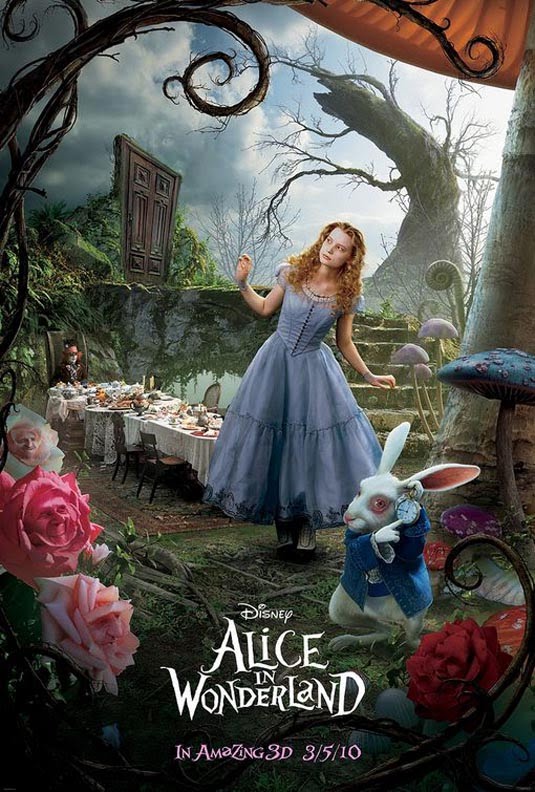
Whip It! and The Chronicles of Narnia: Alice in Wonderland

Two films that have been on the top of our queue for months that both underwhelmed.

Whip It! - There was a tremendous amount of buzz with this film. It's been a "Very Long Wait" for a very long time and has had fantastic reviews. But we were left feeling with a sense of what could have been, rather than amazed at what we were shown. The film is full of little teases that pull you along hoping it's going to be original and fantastic, from the casting....Alia Shawkat (Maebe from Arrested Development), Ellen Page, and my secret crush Kristen Wiig, to the setting of Austin and Roller Derby filled with the awesome quirks of that sport. But the casting just falls flat, Shawkat tries so hard to be funny, and we see little of Wiig, and when we do she's playing so subtle she's hardly on the screen. All that makes me think it's the directing. In fact, I blame it all on the directing, both as the reason for the film's mediocrtity and for the full showcase of what could have been.
This film really should have kicked ass, as a triumphant girl power film with the tagline "Be your own hero." But it so easily falls into the underdog, newbie sport film. It's directed by Drew Barrymore, with a cast of awesome comedic women (and Jimmy Fallen) (also and the guy who plays the coach, my fav character), set in a cool Austin atmosphere of indie...this film should be great. I hoped so much for it, all the way to the end, but over and over it kept dissapointing.
Final thoughts, though, it was pretty funny, it was great to see Maebe on the screen again, and the Derby girls' names were fun. See it, but hopefully you can forget every other underdog sport film ever made and believe this was original.

Alice in Wonderland - Tim Burton somehow found the lost manuscript collaboration between Lewis Carrol and CS Lewis. Apparently, CS wanted to adapt Carrol's characters into one of his books, where there's a girl transported back to a weird world with talking animals, and two monarchs fighting for power, and a big battle in the end where everyone fights, then the girl goes home to England and is better off.
Or maybe it wasn't the Lewises, maybe it was a Disney executive who thought that up, turning Alice in Wonderland into an epic fantasy world with a huge epic battle and all the strange creatures from the book join forces to battle an evil queen. Then somehow Tim Burton got involved and...
And ripped the original heart out, supplanting Alice 10 years later in a sort of sequel where she doesn't remember being there and is the only one who can save Wonderland, which is now called Underland. Why? Because some scroll with the history of Underland says so.
If I was a fan of the book I would be so pissed. I think it was a great and imaginative piece of work, albeit without a plot, but there was a magical theme to it all, hidden inside the chaos of the characters and situations Alice is in. It's as if this movie attempts to make total order of Wonderland, making the characters make sense, work together and give them all purpose. The whole point before was that it doesn't make sense, Alice is lost. She's dismayed that nothing is proper. Now, they've switched that up, where Alice is now out of order and Wonderland makes sense! Then the Mad Hatter does a techno jig and it's over, after an epicish battle between the Red and White Queens.
Final thought, this film can go straight to hell. (Imagine if I was actually a fan of the book.)

Friday, July 16, 2010

Italian Cinema 101: Or how I came to see Robert De Niro's penis

It's true, this week I was privileged enough to see some full frontal male nudity. Not once, not twice, but thrice. And one of those times was Robert De Niro. All three times were in an Italian epic called 1900. Runtime: 311 minutes. Bernardino Betolucci loves him some wang. What he doesn't love is some editing, because at over 5 hours, this mother was long. Regrettably and horribly long. I fast forwarded through a lot of it, which took away slightly from some of the details, but got me through the whole thing. A few of the craziest moments while I fast forwarded, I re-wound and caught them; i.e. when Donald Sutherland kills a cat by head butting it, and when Sutherland kills a kid when he's twirling him around and bashes his head on the wall. Donald Sutherland later gets chased by a mob of women workers, where they impale him with several pitchforks. Between Donald Sutherland's graphic scenes, and the myriad of penis(including prepubescent boys comparing theirs!!!), this was European cinema at it's most cliche. Oh and there was some drug use. The other European films I've been watching were far less graphic. (P.S. The 1900 DVD is unrated, but the original US release was NC-17. If I had known, I would have passed on this one.)

1900 - Don't see this film. Even if you like male nudity. This film was dreadfully boring. It follows the lives of two men born on the same day in the year 1900 in Italy. One, Alfredo, is the son of the Padrone, a land owner baron, and the other Olmo, a illegitimate peasant. Italy was a crap hole for political turmoil, and their lives surround all that, from labor strikes to WWI, to the rise of socialism and fascism. That all sounds pretty cool, and if it followed Sutherland killing kittens and boys, it probably would be. But the film tip toes around most of the action, from Olmo returning from war (and Alfredo not even going) to just showing people upset a lot and talking about the turmoil the country is in. And then a whole lot of random things, like Olmo and Alfredo sharing a prostitute, where we see De Niro's and Gerard Depardieu's penises. It's meant to be at its heart a tale about the rights of workers and class struggle, but when you talk about it more than show it, it defeats the purpose. (And what do penises have to do with class struggle?) The ending comes close, though, after the second war, when the peasants are "cleaning house" of all the fascist, and Sutherland gets his just desserts. It's a tall task to make a five hour epic set around two world wars, social uprising and lots of penis and still be majorly boring. But when you look at the base story, a rich guy and a poor guy who are friends, yadda yadda, just watch Disney's Fox and the Hound and use the extra four hours of your life to do something meaningful, like build a doghouse.
Roger Ebert agrees with me!!!

The Conformist - Somehow directed by the same Italian director that loves penis, this film contained no male nudity!!! (Only a hint of lesbianism and a  flashback that almost results in molestation.) Hooray. (But it was made before 1900, so maybe he thought something was missing from his films.) In 1900, Betolucci uses ham fists to drive his point up your "you-know-what"; i.e. the two childhood friends fight and fight, all the way to the end as old men, when they fight in the fields, all representative of the eternal class struggles. But here, the ham fist comes from the title. The main guy is a conformist. How do we know? The title makes it clear, before we ever see the film.
The plot according to them is of a guy working for the fascist government as a hitman killing enemies of the state. His next target is an exiled professor he had as a student, who according to lots of dialogue, was the man's mentor. Funny, though, in the film the man never shows affection for the professor or any kind of feeling that the man had any lasting impression. Except there is one really nice scene when they meet again for the first time and talk about Plato's allegory of the cave. That discussion sort of mirrors a lot of the themes of the film, as the man maneuvers between the light and dark of his life, as well as the light and dark of the world around him, and around Italy, with the rise of fascism. The film actually is visually remarkable, using light and dark mystically as well as some other remarkable shots. I think this film was very influential to 1970's American cinema, because you see many film elements in this crop up into later films. Stylistically, this film sets the tone for the 1970's, which was a re-birth in American film starting with The Godfather and moving on to other darker and grittier films like Taxi Driver and even into science fiction of the decade.
The Conformist was great, but forgettable. After watching it, I felt like I liked it, but after a week it had basically left all of my consciousness. But in a way, that's what films do, however, it actually may imply that I didn't identify or relate to the protagonist in any meaningful way. I should have. On paper, his story is deep and interesting, and something we all face: being an individual in a conformist world. But the film just wasn't effective enough to reach that deep. Maybe if I saw his penis I would feel differently.

Tuesday, July 6, 2010

Saved vs. Juno: Battle for Pregnancy Supremacy

I try not to review films from the queue that I've already seen, but apparently I give too many negative reviews. So I decided to review Saved, a film I love.

Juno got buzz like no pregnancy film has in a long, long time. And now, young girls getting knocked up has become a slight trend in film and TV, with Secret Life of An American Teenager, The Pregnancy Pact, 16 and Pregnant, Teen Mom, Knocked Up. And then even Away We Go, even though they aren't too young, still it, like The Office and Waitress deal with young adults coping with a first time pregnancy. It's also a case of either life imitating art or the other way around; with the high school girl pregnancy pact that happened a few years ago, and teen celebrity Jamie Lynn Spears going the family way.
But Juno was the height of the pop culture pregnancy boom. It was a critical and commercial success, earning Oscar noms and a screenplay win, which is quite a surprise, considering the story has been told before, and actually the premise is quite simple. But just like some of 2009's Best Picture noms, like Precious, The Blind Side, or even An Education, it very easily could have been an after school special or straight to video. But even more realistically, it seemed destined to just be an indie darling that people love, but gets avoided come awards season. That's exactly what happened to Saved!.
Saved and Juno follow very similar premises; a high school girl gets pregnant and has to deal with the social realities of the "problem." Except the differences lie in what those social realities actually are. Juno very well could be the secular Saved. In Saved, Mary is a good, Christian girl trying to do what's right and follow her faith. Her boyfriend reveals that he might be gay, and she has a misguided vision of Jesus telling her to help him. The only way she can figure to help is by keeping him on the right side, and they have sex. (But still trying to have some decency, she keeps her bra on during it.) Her boyfriend gets sent to Mercy House, a Christian insitution designed to "heal" teens of what ails them, and Mary gets pregnant. The film follows Mary through the school year, dealing with her faith while hiding her pregnancy from her peers, including A-type personality Christian girl, Hillary Faye.
In Juno, Juno gets knocked up by her pseudo-boyfriend Bleeker, played by short shorts wearing Michael Cera. Here, she comes out quick, telling her parents and not hiding anything. She decides to give the baby to a barren couple wanting a child. Even though the plot of Juno revolves around the pregnant teen, it's as if the film is about something else, though. It's just about a teenage girl with average problems, struggling to build and maintain relationships. As though, the pregnancy wasn't that unique, she's just an average American teenager with a typical problem. And like all the TV shows that came out afterward show, it doesn't seem like it's that unique of a problem. And since it isn't that unique of a problem, the film should just be an example of art imitating life. And honestly, that's where it ends. Juno isn't that deep of a film. It's good. The characters are well written, the story is interesting, there's a lot to relate to. But by the end, how much is the film asking?
And that's why Saved is a better film. It's a satire, and feels slightly on the nose at times, with the Modern-Day Christian sayings that the kids say, and the situations you could see a mile away. But beneath that, there is great comedy that asks real questions, and not just for the Christian community. At times, it felt like the film was making fun of the new American Christian movement, but mostly you get the feeling that they're laughing at themselves, and seeing their own pitfalls. And by extension, this film is really about American society, and our coping with our collective faith and living in the real world.
It's rightly set among teens growing up with the faith of their fathers, and their fathers' trying to interpret the world for them. It's the character of Patrick, the Christian Dean's son, that we can most admire, because he's the one that is internally asking the questions and facing the world himself without any outside dilemma, like Mary. Whether you're religious or not, Saved is a great cultural film that actually takes a peak inside what's going on with America today. And even though it revolves around the same topic that all these other films, Saved actually asks real questions, even if it doesn't give all the answers.

Wednesday, June 30, 2010

2 of FW Murnaugh's classics - Faust and The Last Laugh

In between World Cup matches I've managed to fit in a few classic films, notably two of FW Murnau's silent classics. The wacky schedule of the world cup and working the last few weeks have messed up my sleeping patterns, so with regret, I must admit there were a few times I almost dozed off while watching these and had to split them up over a few nights. That's not too awful, I also fell asleep during Metropolis, one of my favorite films of all time.
More than anything to take away from Murnau's films are the innovation of the camera and style. He invented the unchained camera technique and also the subjective camera (where the camera acts as a character's eyes.). He changed film in a number of ways, and in more ways than can be seen by watching his films; his impact was felt in both European cinema and American and ever since. But how good are his films individually when looked at as movies by themselves on the merits of their stories?

The Last Laugh - Style, tone, cinematography. For a silent film not dealing with war, this was a very visual film. Not as visual as Faust, but considering it centers around a lowly doorman, that's saying something. It follows the doorman of a luxury hotel in a bustling city, who works hard, going above and beyond the call of duty. He cherishes his job, feeling a huge sense of pride, when he arrives home, still wearing the big doorman outfit. He's respected through the whole neighborhood; by the kids, the gossipy women, everyone loves and respects the guy. That's probably due to the fact that it's a poor neighborhood and his suit gives him the respect; he doesn't work in a factory or doing something lowly, and the beautiful suit shows that. In fact, it seems the man's whole life is sustained and revolves around the suit; a symbol for his pride and achievement. Even though he isn't rich, at least he has a purpose and some kind of status.
So when the man loses his job, being relegated to a washroom attendant, his life falls apart. He steals the suit and wears it home, so no one knows the difference. His daughter is married, he has to work and can only attend the reception that night, but even though he has the suit it's not the same. He feels different, and that night he has weird dreams. Eventually, everyone finds out he is not the doorman any longer. Since it's a silent film it's hard for people to talk and explain things, so the man cannot explain that he was just demoted the day before. But everyone thinks he's been lieing to them the whole time and humiliate him as he comes home. Even his family doesn't accept him, his wife who found out because she brought lunch to him earlier and saw him working in the bathroom. She cries and won't see him, so he goes to the hotel bathroom and sits under the window. The film should end on that note, or something that could fit the tone of the film, or end with a believable redemption. Instead, there is a title card that says the author took pity on him, and the man wins a huge inheritance. He gets the "last laugh" while eating in the hotel restaurant and going around the hotel, again feeling pride and prestige. This ending I think may have been influenced by, rather than been an influence like so much else in the film, the plethora of other silent films ending with happy coincidences that put the hero back on top with no help of their own. Silent American films are notorious for it, from Chaplin and many of the silent comedy films.
So is the film a prophetic metaphor about uniform-loving Germany? After getting kicked in the face in the Great War, will they eventually have the last laugh? Probably not, Murnau left Germany two years later. But I think the film is about and for the German people. The 20's were a tough time for Germany, they were financially struggling, dealing with domestic disputes as well as being ridiculed and abused internationally. The German people needed something to lift them up, to give them a sense of purpose. The suit the man wears is a symbol of that. He wasn't making so much money that he could move his family to a nicer home, but with that suit he could feel more important and thus have a purpose. But the problem lies in placing too much emphasis on that. The people in his neighborhood turned him from a Grandfather figure to the laughing stock of the neighborhood in one quick turn. The man probably still made about the same amount of money, working in the wash room, he just didn't have a cool looking suit to wear, and rich people stopped smiling at him, like when he opened the front door and tipped his oversized cap at them.
The Last Laugh is great social commentary, especially for the German people at the time. But the story lags slightly, maybe because of the few title cards used, but mainly because the story just doesn't have much action. The ending almost ruins the film, but the overall tone and meaningfulness of the story make up for it, leaving a lasting film that's a classic on many levels.

Faust- And then there was Faust, similar but totally different. All the mood and glimpses of German expressionist stylings in The Last Laugh, are exemplified here. From the story to the sets and everything in between, this film typified the German expressionist film movement. The story is dark, following the legend of Faust, who sold his soul to the Devil. It opens on Mephisto betting with an angel that he can corrupt a righteous man's soul. If he can, the angel will give him the world. I don't know how the angel has power to do that, or why he has so much faith in men, but the deal is made, using Faust as the man. The story takes place probably around renaissance times in Europe, and Faust is an alchemist with a big heart. Mephisto's first step is to bring down a plague on the city, for which Faust is helpless to stop and save anyone. Then, he curses God and turns to the Devil. One thing leads to another and bam, Faust sells his soul after a mini trial run of unlimited power.
The one real problem with the story is that Faust so quickly turns to the Devil, when he's supposed to be so righteous. Why did the Angel offer him up as the example when he turns so quickly? Judging by his career choice, he was already trying to play God with chemicals. But that's the issue with most silent films, the camera just accepts whatever it sees, from over reacting to things to turning on a dime.
By now, I've figured out that Murnau is not the best storyteller, but that doesn't matter. His ability to infuse his style and tone in the mood is remarkable. Faust uses some great visual story techniques, from Mephisto towering over the village(a la Fantasia style) to when Faust and the devil are flying over the countryside. This film is worth it merely for the visuals, which is absolutely remarkable for the silent era, barely being surpassed by Metropolis.

Monday, June 21, 2010

An Indie Fair

The Imaginarium of Dr Parnassus - Heath Ledger's last film. Not Terry Gilliam's best, but I could say it's his most imaginative. It revolves around a device bringing imaginations to life, so that's obvious. But what often happens when a story opens the door to no limits, the story looses control. Fiction thrives on rules, and sometimes when those are thrown out, you throw out some of the audience's connection and thus interest. That wasn't so much the problem here, though. The problem was that some of the details of the production were lacking, some out of the director's control, (i.e. the lead actor's death). Others, like casting Vern Troyer or Mini-Me fame, were in his control. We can see since Austin Powers why he was mute in those films. Whenever he opens his mouth he butchers even the best dialogue. Some of the best lines of the film are written for the character, but are either overshadowed by the superior actors or are just flat out spoken with no acting experience whatsoever. Terry Gilliam loves little people, but there just must have been a way around getting the tiniest actor around. Just go for a normal midget! (Is that an oxymoron?)
All in all, I actually liked the film. Gilliam's style showered through the trite story and bad acting to bring his imagination to full CG mode. Watch out world, Terry Gilliam has discovered computer graphics!

Metropolitan - This was on SDSU's recommended viewing list, which I will be journeying through for the rest of the summer. It's kind of a tiny touchstone independent film from 1990. It didn't make the same waves as Reservoir Dogs or Eraserhead did, but I can see some of it's influence in later 90's indie films. The film focuses on a group on young Manhattan socialites, home for Winter Break, during the Debutant Season. The group befriends an outsider named Tom, not a "urban haute bourgeoisie," as Charlie, one of the members of the group coins for their social status. For most of the film, the group gathers after the debutant dances at one of the groups parent's apartments. The parents are never shown, except Tom's mother. Through every scene there are only two topics usually: some philosophical debate about social status in America (where the "UHB" term comes from) or discussing group dynamics and bad mouthing other socialites not present. Usually the debates center around Charlie, who brings up some topic after another person uses a phrase or casually mentions something, then Tom is forced to counter. But sometimes the scenes start in the middle of Charlie's musing about the state of American elite, or the neglected notion that in America it's just as easy to be "downwardly mobile."
For some reason, the film is interesting. I couldn't put my finger on why, though the fact that I was conscious of that may tell something to the film's sustainability. Even though the dialogue and scene structures seemed off the mark, the things the characters said was fascinating enough to be able to overlook the slow pace and lack of plot. The plot of film, which basically follows Tom on a sort of quest of discovery, takes a backseat to the conversations and after party scenes. He keeps being paired up with Audrey, who is like the spitting image/personality of Molly Ringwold, only dark haired. Tom is middle class, and he's been "invited" by this group of upper-class young adults to join them. It's as if, he's getting the call to be "upwardly mobile." But he's reserved about it, and for good reason. The ties that bind the group fall apart, leaving to Tom to see if any of the friendships have stuck. Indeed, the best does, with Charlie. As the group is breaking apart, going back to normal routines, Charlie goes on a journey to get Audrey, who it seems Tom finally realizes they are a good match. They have to get to the Hamptons, where's she's staying with some people at a total douche's house. Neither Tom nor Charlie have licenses, and must take a taxi all the way out there. Through that, they muse about their inability to rent a car (a very basic and everyday sort of thing they point out) and that that may be a sign of sliding downward.
Comparing this to Noah Baumbach's films, especially Kicking and Screaming, about a group of college-aged young adults, this film is very comparable. However, the dialogue is so much smarter and interesting. Even if in Metropolitan the dialogue seems unrealistic at times, at least what they're saying is deeper and has some social commentary.

Eraserhead - This is the film that brought David Lynch to the world, and actually it's the first film of his I've ever seen. I've seen parts of Dune and episodes of Twin Peaks, but never have I seen something of his entirely. And let me say, even seeing it entirely, I felt like I was only catching half the movie. The different scenes and segments bounce around that's hard to tell what's a dream or how much time has passed at all. Most of what you see on screen could just be a part of a bad dream, from the mutant baby to the lady singing in the radiator.
I don't mind ethereal images and scenes, but this tilted a tad too much into the unintelligible. The film was a little too dreamlike to matter. It keeps your interest, but even when the tension rises from an ugly or dreadful image you are so detached from what's happening all that's keeping your interest is curiosity.
Like Dr Parnassus, Eraserhead is running wild with it's director's imagination, only here Lynch is using the images to make the audience uncomfortable and feel the dread that the main character is being pulled through. But it seems like it isn't working because Henry is never really frightened, only barely tense at times. He was like The Tramp lost in a surreal industrial world, hardly speaking and just wandering from place to place.
Maybe he was being controlled by the man on the planet pulling levers, or maybe just being taken over by weird flagella. Who knows, and David Lynch won't ever reveal the true meaning. The meaning aside, Lynch has managed to build a weird world littered with unexplainable symbolism that cuts to the heart of dread and turmoil without ever putting his main character or the audience in real danger. That takes true mastery of the art of cinema, and this film falls squarely in the art category.